
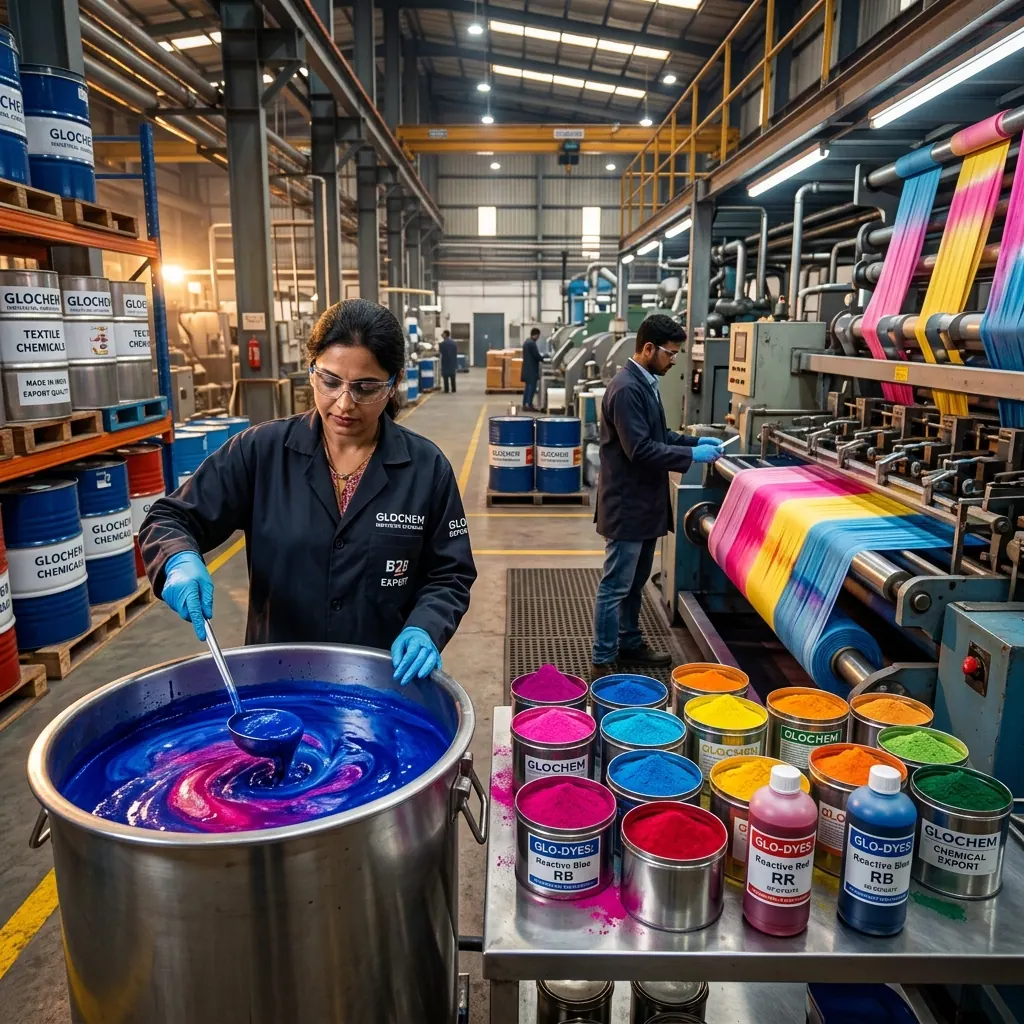
Reactive dyes form covalent bonds with cellulose. Learn how ME, HE, and vinyl sulphone (VS) grades differ, what fixation rates mean for effluent, and how India exporters support REACH/ZDHC buyers.
Reactive dyes are water-soluble colorants that chemically bond to cotton, viscose, and other cellulosic fibers. Buyers choose them when wash fastness and shade reproducibility matter more than pigment printing alone. Chem Horizons supplies high-fixation ME, HE, M, P, and vinyl sulphone grades for export dyeing houses — see the full reactive dyes catalog.
What are high-fixation reactive dyes?
High-fixation reactive dyes maximize the share of dyestuff that bonds to fiber instead of washing off into effluent. Bi-functional ME and exhaust HE systems typically target fixation in the mid-to-high 70% range depending on shade depth, salt/alkali profile, and fabric preparation. Higher fixation usually means lower dye cost per shade and cleaner wastewater.
ME vs HE vs vinyl sulphone (VS)
- ME (bi-functional) — balanced reactivity for exhaust dyeing; strong reproducibility on cotton knits and wovens.
- HE (high exhaust) — designed for deep shades and efficient exhaustion cycles on cellulosics.
- Vinyl sulphone (VS) — widely used for cotton dyeing and printing where alkali fixation chemistry is controlled.
- M / P cold series — suited to lower-temperature or printing routes where process windows differ from hot exhaust.
Compliance buyers ask for: REACH & ZDHC
Global brands increasingly require dyestuffs aligned with EU REACH registration pathways and Zero Discharge of Hazardous Chemicals (ZDHC) manufacturing restricted substance lists. Specifying compliant reactive dyes early reduces lab-dip rejection and delayed shipments. Request TDS/SDS on the reactive dyes product page or via contact.
Buyer checklist before first order
- Fiber type (cotton, viscose, rayon blend) and dyeing method (exhaust, continuous, print).
- Target shade library (Pantone / physical standards) and fixation expectations.
- Required certificates: REACH, OEKO-TEX pathway, ZDHC MRSL alignment.
- MOQ and packing (typical export lots start around 1 MT per grade for sea freight).
FAQ: reactive dyes sourcing from India
Why source reactive dyes from India?
India is a major global hub for reactive dye manufacture and export, with deep textile dyeing ecosystems in Gujarat and neighboring regions. Exporters like Chem Horizons combine grade depth with documentation support for overseas mills.
Do you support custom shade matching?
Yes. Submit a fabric swatch or target reference; lab dips and recipe guidance can be developed before bulk commitment.
Related reading: pigment paste vs reactive dyes for textile printing · shop reactive dyes.