
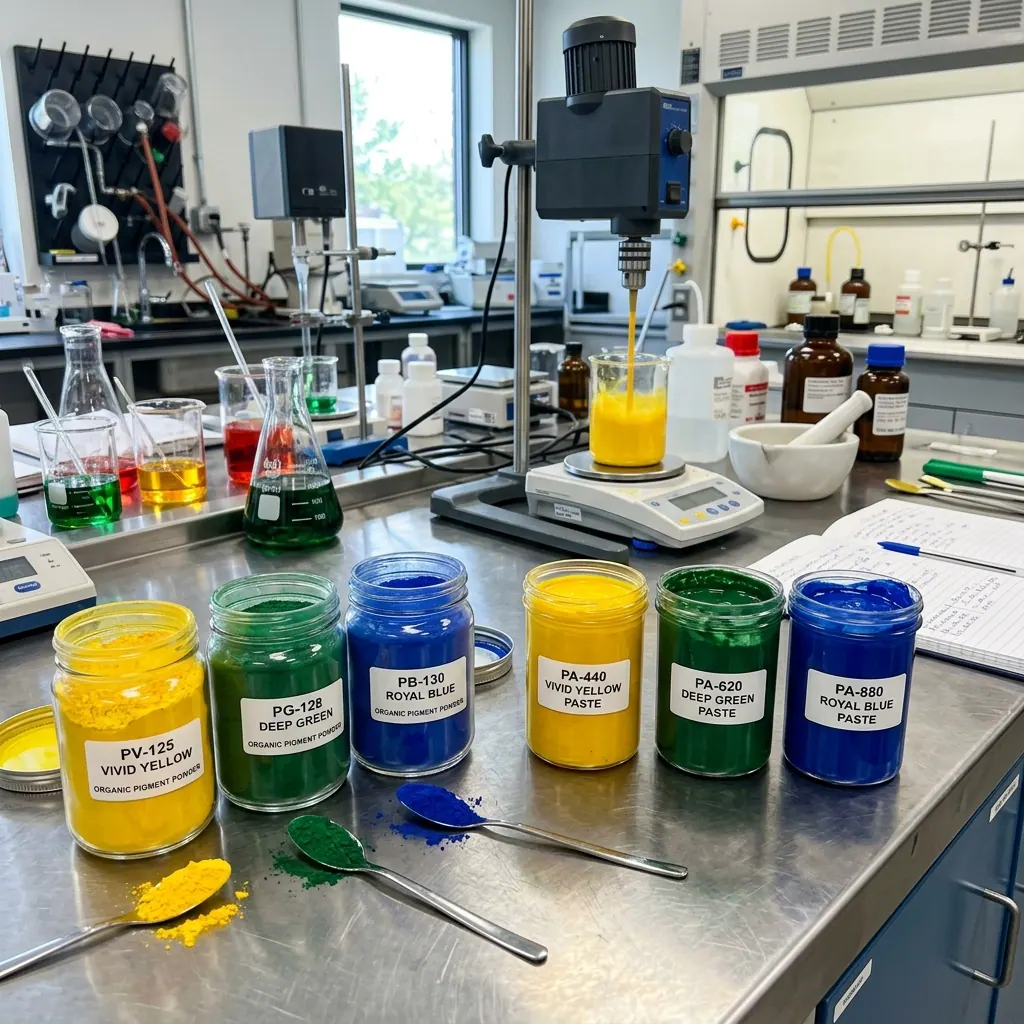
Compare textile pigment paste emulsions with reactive dye printing. Learn when aqueous pigment dispersions win on process simplicity, and when reactive systems win on hand-feel and wash fastness.
Textile pigment paste (aqueous pigment emulsion) prints color mechanically bound with a binder system. Reactive dyes print or dye by covalent fixation to cellulose. Both are used in India's textile hubs — Chem Horizons supplies pigment pastes & organic powders and reactive dyes.
Quick comparison
| Factor | Pigment paste | Reactive dyes |
|---|---|---|
| Bonding | Binder film on fiber | Covalent bond to cellulose |
| Wash-off | Minimal dye wash-off | Needs soaping; effluent load higher |
| Hand-feel | Can feel stiffer if binder heavy | Softer hand when well processed |
| Substrate range | Broad (incl. blends) | Best on cellulosics |
| Process | Print → dry/cure | Print/dye → alkali fix → wash |
When pigment paste is the better choice
Choose aqueous pigment dispersions for multi-fiber blends, shorter process routes, and prints where wash-off effluent must stay low. Solid content for textile pastes commonly sits near 35–45% pigment loading depending on Color Index, delivering strong yield in print paste recipes.
When reactive dyes win
Choose high-fixation reactive systems for deep cotton shades, superior wet fastness after proper soaping, and programs already built around exhaust or continuous reactive chemistry. See our ME / HE / VS reactive dyes guide.
Organic pigment powders beyond textiles
Phthalocyanine Blue 15:3 and Green 7 remain workhorses for paints, inks, and plastics thanks to heat and weather stability. Pair powders with wetting/dispersing additives to avoid agglomerates that kill gloss and strength — covered also in organic pigments for plastics and coatings.
FAQ
Are your pastes compatible with acrylic binders?
Yes. Chem Horizons aqueous emulsions are formulated to disperse in common acrylic and polyurethane binder systems used in textile printing.
Need REACH documentation?
Export grades can be supported with REACH-oriented documentation pathways — confirm per Color Index on inquiry.